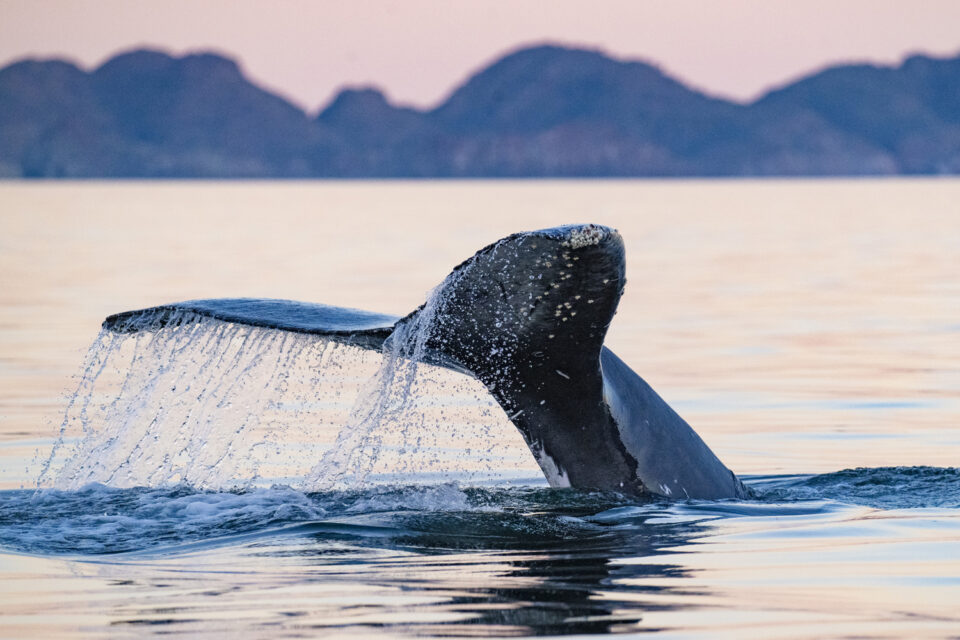
Every winter, like clockwork, pregnant Pacific gray whales arrive in a trio of sheltered lagoons along the Pacific desert coastline of Mexico’s Baja Peninsula. The whales are remarkable for the lengthy migration they make every year between their summering grounds in the Bering and Chukchi Seas where they gorge themselves and fatten, increasing their weight by up to a third, and their calving and mating lagoons in Mexico, about 6,000 miles to the south. It is one of the longest annual migrations by any mammal. In their five-month feeding binge in the Arctic, a hungry gray whale may consume 67 tons of food (1.5x its own body weight) increasing its body weight by up to a third and adding six inches of blubber to its body.
In winter, the first gray whales to arrive in the Mexican lagoons are pregnant females, followed by females in heat, adult males, and juveniles. They arrive in the lagoons in late December and early January with the greatest number of calves being born at the end of January. Our gray whale photo trips are always timed to coincide with the peak number of whales, when many young calves are a month old and curious to explore their world, which we always hope will include our boats as we quietly bob on the ocean.
At birth, a newborn gray whale calf is 16 feet long and weighs about 1,760 lbs. Mothers and their single calf are inseparable for the first month while the two imprint on each other and while the calf eagerly nurses and gains weight. A mother’s nipples are recessed in shallow slits on her belly so when a calf wants to nurse it must nudge its mother who then forcibly ejects a stream of milk into the calf’s mouth. Gray whale milk is 53% fat. Compare that to a dairy cow whose milk is just 4%. Each day, a whale calf will drink roughly 53 gallons of milk. That is equivalent to the average amount of milk produced by 6 ½ adult dairy cows. On this rich diet the calf gains two pounds or more an hour which translates into as much as 50 to 60 pounds in a day, doubling its birth weight by the time it begins migrating north with its mother in spring.
In April, the last of the whales head north to the Arctic to their summer feeding grounds. This year, gray whale numbers were especially numerous with over 600 whales being reported in Laguna Ojo de Liebre, where the whales did not disappoint us with their legendary friendliness and approachability. There were moments when as many as five whales were swimming around our panga, spouting beside us, blowing bubbles on the underside of our boat, and gently spinning and pushing us around as if we were a giant bathtub toy. One newborn calf was so eager to play with us that it repeatedly surfaced beside our boats and allowed most of the group to stroke its sides and rub its chin. The youngster would even roll on it’s back so that its belly also got some tactile attention. When this happened, it was hard for anyone to contain their joy or suppress their laughter.
Besides the remarkable gray whale encounters we had this year there were many other highlights to make the trip a memorable one. Some of the special moments included:
- On a morning outing into the Gulf of California we saw three magnificent blue whales, the largest animal to have ever inhabited the planet, and managed to photograph it for an hour as it repeatedly dove allowing us to capture its 30-foot-tall spouts and 20-foot-wide tail flukes again and again.
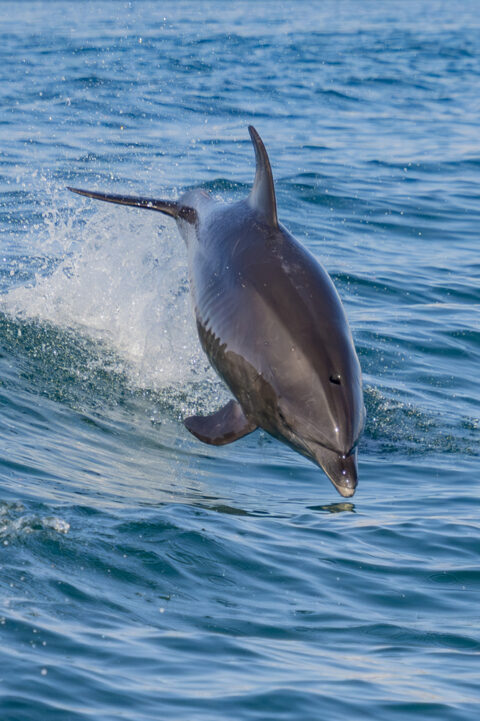
- Two pods of playful bottlenose dolphins as they chased and leaped in the wake of our boat.
- Multiple dense patches of crimson krill which explained the boisterous feeding lunges of four different humpback whales as they fed on the surface of the gulf in the golden light of sunset.
- Noisy groups of female California sea lions lounging on rocky coastal ledges, each overseen by a harem bull that periodically barked his ownership to neighboring rivals.
- Several dozen pairs of nesting ospreys some of which were incubating eggs while their attentive partners brought them meals of headless fish.
- A Sonoran pronghorn breeding facility where we had the rare opportunity to photograph a newborn fawn, still wet with amniotic fluid, take its first wobbly steps on spindly legs.
- A rare sighting and closeup photo opportunity of a female tarantula as it crossed the road and obligingly climbed onto Wayne’s arm.
- A visit to Cueva del Raton in the San Francisco Mountains, a rocky overhang where we saw 2,000-year-old rock art depicting bighorn sheep and a crouching mountain lion drawn in red and black pigments by ancient indigenous hunters. The drive to and from the cave traversed picturesque dramatic plateaus, cut by deep desert canyons, and cloaked in a great assortment of cactuses as well as famous endemic boojum trees.
- The sensual curves of the Solitude Dunes which challenged the artistry of our vision.
- Four of the peninsula’s most splendid Spanish missions dating from the 1700s, giving us a glimpse of the early influences of European culture on the native hunter-gatherers who had inhabited the area for over 10,000 years.
In summary, the trip was an overwhelming success, and the complimentary words of the participants reflected this sentiment convincingly. Some of the comments included: “The whales of Ojo de Liebre are unparalleled.” “A trip of a lifetime.” “A wonderful life experience and thank you for the knowledge you willingly shared.” “A visceral encounter in which the photography was a plus.”
I am leading the trip again in February 2027, so if you need a rejuvenating, inspiring, and photographically productive winter getaway, this is a trip to consider!