
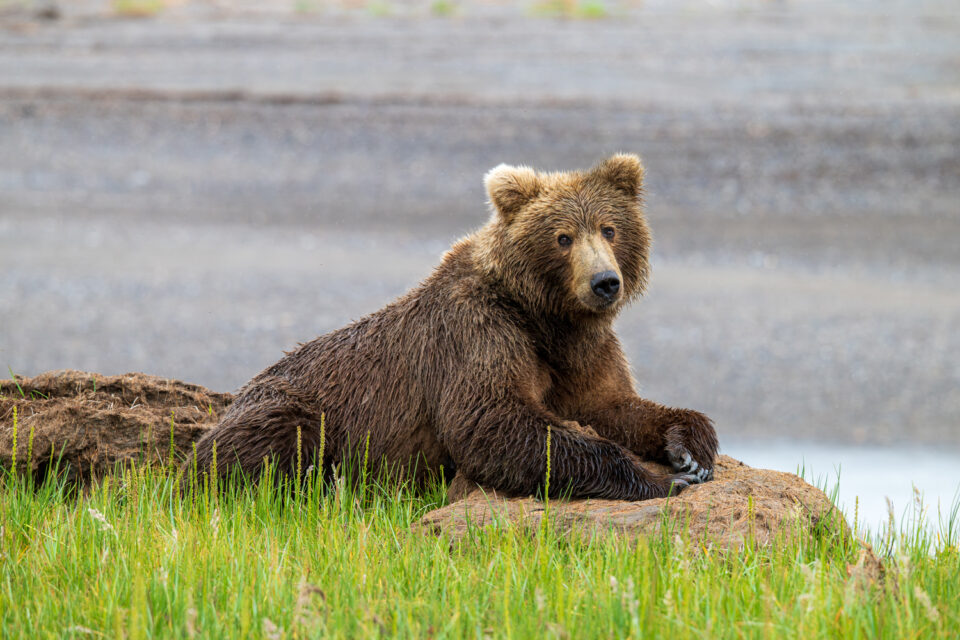
Every bear tour has at least one unforgettable moment. During our July trip, we were standing about 50 feet from a mother brown bear and her two 7-month-old cubs as they fed on sedges. Suddenly, one cub rose onto his hind legs, faced us, and began moving his front paws as if he were clapping—like a child playing patty-cake. Still standing upright, he then lifted both paws toward the sky and gazed into the clouds. Our group burst out laughing. It was the best imitation I have ever seen of a bear striking the classic pose of a clergyman preaching to the masses at the climax of an inspirational sermon. What prompted this unusual behavior? It was motivation, but not of the religious kind. The cub had jumped up and swung his paws attempting to catch a small butterfly—which he completely missed!
One of our most exciting photographic moments during the August trip occurred when an adult female brown bear located a school of migrating salmon coming up Silver Salmon Creek. She plunged into the water right in front of us and began chasing the salmon but the problem was that the water was about two feet deep, and the bear could see them from the elevated bank or from a vertical standing position, looking down on them, but once in the water on all four legs appeared to lose sight of them. This resulted in the bear frantically and repeatedly charging through the water for about 20 or 30 yards in front of us each time, then jumping back up on her hind legs to try and locate where the salmon were again. It was frustrating and unproductive for the bear, but it was amazing to watch and even better to photograph.

As wildlife photographers, we tend to avoid storms, especially when strong winds are blowing. That instinct makes sense: harsh weather is uncomfortable, hard on expensive equipment, and often unproductive because the animals we hope to photograph tend to hunker down in dense cover. But when you are dealing with winds, waves, and coastline bears it might be worth a try. During our August tour those conditions created a rare and exciting opportunity. One adult female brown bear repeatedly walked along the shoreline as unusually large waves broke directly behind her. Seen through long telephoto lenses, the waves appeared even larger, creating a dramatic and beautiful background that was a product of the “bad” weather. I have led 14 tours at this destination, yet it was only the second time I ever saw such powerful surf so close to the bears we were photographing.
For more than a decade, Homestead Lodge has served as the base for all our brown bear photography tours in and around the Lake Clark National Park area, offering exceptional hospitality from an authentic 1950s homestead in a wilderness that can only be reached by bush pilots and boats. This was not just designed to “look like” a wilderness experience, this was the real thing. Our groups were treated like family members by the owners, their chef, their guide and other employees. Incredibly delectable breakfasts, lunches and dinners were created at least in part, from a small but prolific garden in the yard, local wild berries and plants, and fresh salmon captured less than a mile away. We were all served at one dining table essentially in their home in plain view of their kitchen, where we could watch the food preparation in one direction, and often watch bears crossing the yard or an adjacent meadow from huge windows in the dining and living rooms in other directions. Regulations on bear viewing were much less here than in most other bear viewing areas because of the relatively small number of people that visit the area. And the timing and duration of photographic activities were mostly dictated by the desire of the group to be in the field based on light conditions and bear activity rather than just convenience to those providing the services. This didn’t feel like we were at a bear viewing “facility”, it felt like we were at home.

One of the most maternal things you will ever photograph is a mother bear nursing her cubs. It’s very difficult to get that shot at many of the best-known bear viewing areas because the density of bears is too high. High bear densities are caused by concentrated food resources—most notably rivers with abundant salmon populations, and often just below waterfalls where salmon concentrate before getting above the falls. This causes a huge increase in competition, aggression and greater probability of serious fighting, injuries and cub fatalities. Large male bears will sometimes prey on cubs at these locations—While leading photo tours I have witnessed two different brown bear cubs being killed by adult male brown bears along the Brooks River in Katmai National Park. So, females with cubs of the year tend to shy away from those high bear density areas and try to find food in areas with lower bear density—like the meadows and beaches near Homestead Lodge where they feed more on sedges and males are not so abundant.
Of the 14 bear tours I have led at Lake Clark National Park over the past decade, we have been able to photograph mothers nursing cubs during all but one—and during some trips we have many opportunities. On TV and in newspapers, magazines and books we so often hear or read about the terror and aggression of brown/grizzly bears, but rarely do we hear of the amazing maternal behavior of mother brown bears with their cubs and amazing tolerance of humans. That is one of the key highlights of photographing brown bears at areas like Silver Salmon Creek.
I’ve been leading bear photo tours for over 40 years, at a variety of destinations. This was my 13th and 14th tours for brown bears at Lake Clark National Park. No two tours have ever been the same, but I have thoroughly enjoyed each of them. I’m scheduled to return July 4 – 10, 2027, which I am very much looking forward to, and I hope you can join me!


