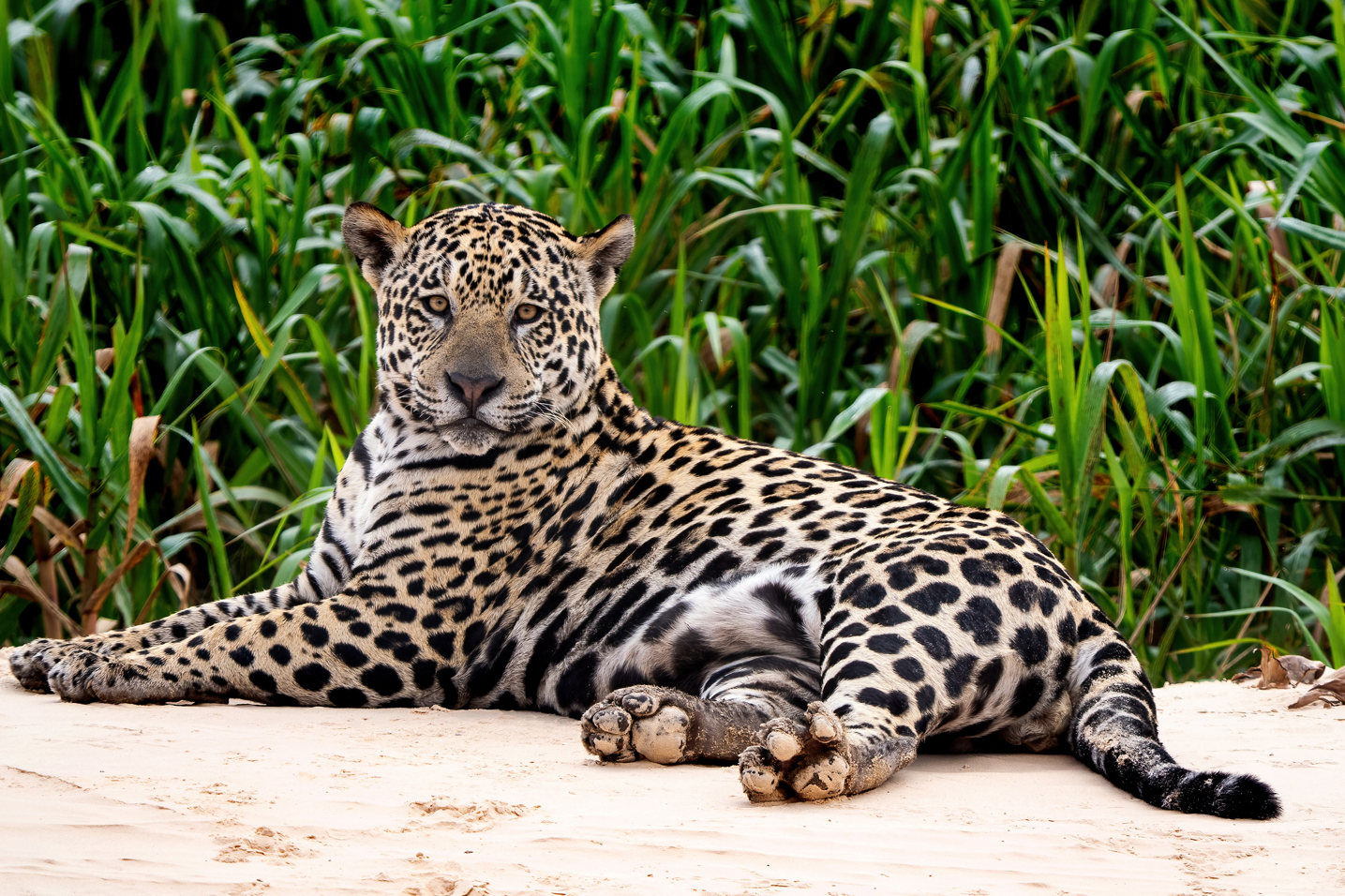
A tour is always a success when you can deliver the subjects advertised on the website and that is exactly what happened in both of my photo tours to the Pantanal in August. Not only did we have 25-30 jaguar encounters on both of the trips I led, but we also had some remarkable photo opportunities with multiple other wildlife species. Clients repeated commented on their surprise at the diversity of subjects we were able to capture with our cameras. For some, it was the best wildlife shooting they had done in their lives which was not a surprise to me at all. In his fact-filled book Pantanal Wildlife, British travel writer, James Lowen writes. “In some ways, the Pantanal is to the Americas what the Serengeti is to Africa. The world’s largest wetland showcases some of the most breathtaking gatherings of birds, reptiles, and mammals that you could ever hope to see…The Pantanal, in short, is a wildlife watchers paradise.”
This was my 13th trip to the Pantanal and it was anything but unlucky despite the ancient folklore about the superstitiousness of the number thirteen. The routine we followed on the two tours I led and the three different locations we visited were the same as I have chronicled in my previous trip reports so rather than bore you with tedious repetition, this year I would like the photos to speak for themselves and feature more of them than usual and limit my reporting to a few of the more outstanding wildlife highlights.
- The Pantanal has been suffering through a decade of low summer rains which has resulted in the wetlands on either side of the Transpantanal Highway being fewer in number but those that remain were often overflowing with wildlife. Such was the case during our drive south to Porto Jofre. I had never seen such a dense aggregation of jacare caimans. In one wetland there must have been several hundred of these scaly beasts crammed together shoulder to shoulder basking together beside the water’s edge.
- There are only three ibis species in South America and one of them, the maguari stork, is quite rare to see yet we had multiple views on both of my tours giving us an unexpected photo opportunity.
- The South American tapir is one of the wildlife “big five” that every traveller to the Pantanal hopes to see. My groups had multiple photo opportunities including one of a tapir feeding at a salt lick, another time we saw several swimming the width of the Cuiaba River, and one tapir displayed its breath holding capability by fording the river by walking underwater, only reappearing when it reached the shallows along the far shore. The most memorable encounter of all, however, was of an unsuspecting tapir walking beneath a wooded slope where a jaguar was crouched less than 10 feet above it.
- Watching a jaguar make a kill is what every photographer hopes to capture, and both tours saw multiple unsuccessful leaping attempts and at least one successful caiman capture each. In one case, the jaguar, an 8-year-old female dragged a large caiman up a steep slope through a tangle of thick vegetation and another time a juvenile female hauled a caiman as large as itself along a sandy beach for 200 yards. For a jaguar to be exposed with prey is an unusual event and afforded hundreds of images to be captured. What a visual thrill it was to see.

- As always, the lodge at Rio Claro had four stocked bird feeders scattered around the hotel grounds and the photo opportunities were outstanding. The avian subjects included endemic chestnut-bellied guans, handsome bare-faced curassows, loquacious, black-hooded parakeets, multi-colored, yellow-billed cardinals, golden saffron finches, and resplendent hyacinth macaws, the world’s largest flying parrot and a Pantanal must-see.
- For some of this year’s travellers, the playful antics of several families of giant river otters captured their interest as much as the jaguars. The frantic fishing behavior of the energetic otters was also a crowd favorite and each of us shot hundreds of images hoping to capture the ultimate image.
- Males forming a coalition are a newly described behavior for the jaguars in the Pantanal where the high density of breeding females makes such associations genetically beneficial. Worldwide, of the 40 species of wild cats only lions and cheetahs in Africa also form male coalitions for similar reproductive benefits. This year in the Pantanal, two 3-year-old males were commonly seen and photographed swimming together, grooming each other, and hunting in overlapping home ranges.
- As always, July and August are the months when jabiru storks begin their annual nesting cycle. The jabiru, whose name is derived from the Tupi-Guarani indigenous language meaning “swollen neck” because of the bird’s bloated red throat pouches, is the tallest flying bird in South America, standing up to five feet tall. The stork builds large, conspicuous photogenic stick nests and often perches atop them and we had many occasions to photograph them in different locations.
- At Porto Jofre, our local guide Paulo’s friendship with a resident presented a closeup opportunity to photograph hyacinth macaws, toco toucans and chestnut-eared aracaris that came to his friends’ backyard for water and fruit purposefully put out for them. It was both exciting and challenging to photograph such colorful birds at close range.
These are just a few of the many experiences enjoyed by my tour groups this year. But for most of them seeing a wild jaguar for the first time peering from a tangle of riverside vegetation with the tropical sun beating down and the rhythmic calls of doves and tinamous calling from the shadows was like no other wildlife experience on the planet. Plan to join me in 2027 to experience it for yourself.